

 Posted by
 For most of Dallas’ recent financial-services expansion, the story has been about employment.
Goldman Sachs is building a large campus. Morgan Stanley plans a major Uptown operation. JPMorgan Chase already has thousands of employees across North Texas. Bank of America, Charles Schwab, Fifth Third and other institutions continue to add people and facilities here.
The Texas Stock Exchange introduces something different. Instead of bringing another financial company to Dallas, TXSE is trying to establish part of the infrastructure that public companies and investors use to access the capital markets.
That effort gained an important customer this week.
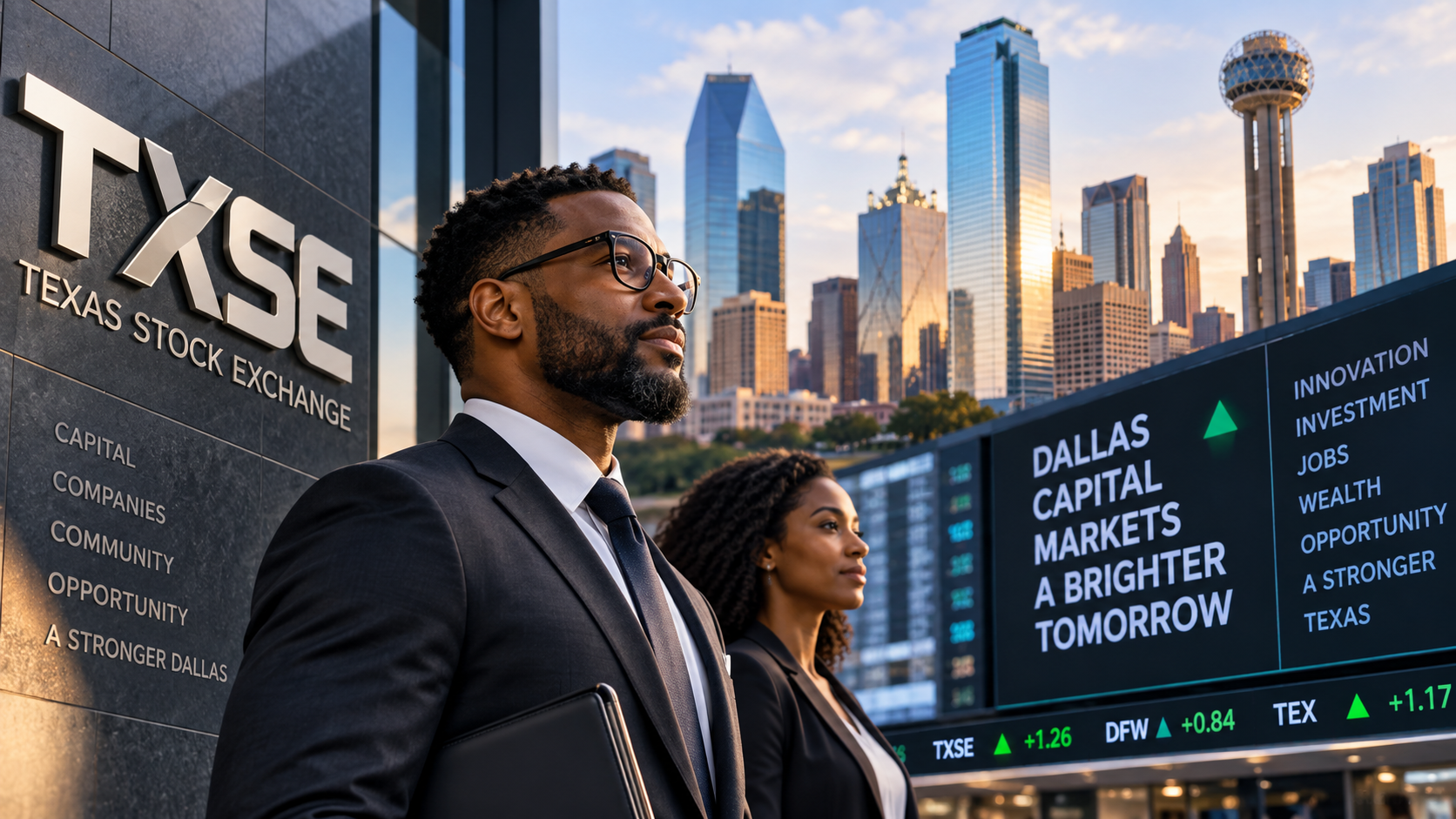
Dallas-based Energy Transfer announced September 10 that it will move the primary listing of its common units from the New York Stock Exchange to TXSE, with trading expected to begin October 5 under the existing ET ticker. Several affiliated companies, including Sunoco and USA Compression Partners, are making similar moves. Together, the companies transferring their primary listings represent nearly $100 billion in market value.
For a stock exchange that began live trading only this summer, that is a significant early test.
What a Primary Listing Actually Means
The Energy Transfer announcement can easily disappear into the broader “Y’all Street” narrative, where almost any financial development in Texas gets framed as another challenge to New York.
The mechanics are more interesting than the slogan.
A primary exchange is the company’s home listing venue. Moving that relationship to TXSE does not mean every Energy Transfer trade suddenly takes place in Dallas; securities trade electronically across multiple exchanges and other market venues. What changes is the company’s principal listing relationship and the exchange responsible for functions tied to that status.
TXSE began live trading in July. It plans to add primary listings for exchange-traded products in September and corporate securities in October. More than 50 member firms participated in its launch.
Dallas is therefore gaining another piece of market infrastructure at the same time that NYSE Texas and Nasdaq Texas are operating here.
That gives the region an unusual concentration. Dallas already had large banking, wealth-management and corporate-finance operations. It is now home to competing exchange businesses as well.
The distinction matters because financial centers develop through accumulated institutions. Employers matter, but so do law firms, technology vendors, market-data companies, regulators, investors, advisers and specialized talent that grow around them.
Energy Transfer Is a Useful Test, With an Important Caveat
The first group of companies moving to TXSE has close Texas ties.
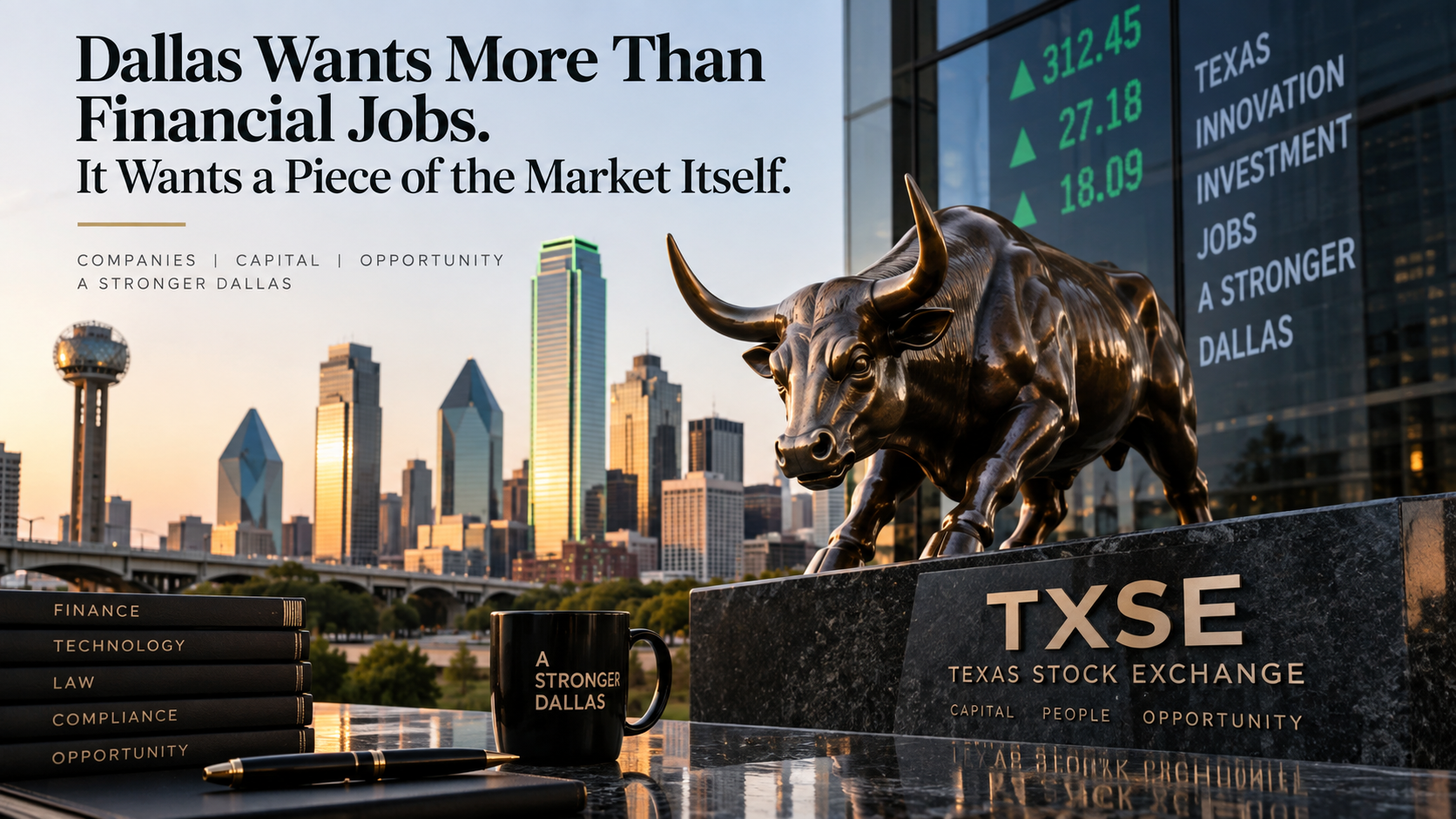
Energy Transfer is headquartered in Dallas, and executive chairman Kelcy Warren has invested in TXSE Group. That relationship makes the transfer less surprising than it would be if a major company with no connection to the exchange or Texas had made the same decision.
Still, a new exchange cannot become credible without issuers willing to list there.
Energy Transfer operates a massive national energy infrastructure business and is widely held by institutional and individual investors. Its decision gives TXSE an operating example that future issuers can evaluate rather than simply a promise about what the exchange intends to become.
TXSE also cleared a practical hurdle when major index providers including S&P Dow Jones Indices, MSCI and FTSE Russell adjusted their methodologies to accommodate securities primarily listed there. Index eligibility matters because many investment products are built around those benchmarks.
The harder work comes next.
NYSE and Nasdaq have decades of issuer relationships, global recognition, liquidity and market infrastructure behind them. Large Texas companies have not rushed to abandon those exchanges simply because new alternatives opened in Dallas.
ExxonMobil and Tesla, for example, have strengthened their corporate ties to Texas without moving their primary stock listings to TXSE.
That is why Energy Transfer should be viewed as an early proof point rather than evidence that the competitive landscape has already changed.
The Dallas Career Story Extends Well Beyond Trading
For most professionals, the immediate opportunity is not likely to be a job at the Texas Stock Exchange itself.
Modern exchanges are highly automated operations. Even a successful one does not need a workforce comparable with a large bank campus.
The larger value may come from the specialties that surround public markets.
Dallas already employs large numbers of people in banking, wealth management, corporate finance and technology. A deeper capital-markets presence adds potential demand for market-structure engineers, securities attorneys, compliance specialists, cybersecurity professionals, accountants, financial-data experts, investor-relations professionals and people who understand highly regulated trading systems.
A software engineer working for a bank might eventually move into securities infrastructure. A cybersecurity professional could build expertise around financial-market systems. Attorneys can deepen their work in securities regulation and corporate governance. Finance students may discover career paths that have little resemblance to the traditional image of a stockbroker.
These are not hypothetical occupations created by the phrase “Y’all Street.” They already exist in financial centers. The relevant question is whether enough of that work begins accumulating in Dallas to make those careers more common here. That process takes years.
There Is a Supplier Market Around Finance Too
The same concentration can matter to entrepreneurs. Large financial institutions purchase technology, cloud services, data platforms, cybersecurity, recruiting, legal services, training, communications, facilities support and specialized consulting. Firms serving highly regulated industries also tend to value vendors that understand their operating environment.
For a Black-owned technology or professional-services firm in DFW, that creates a different strategic question than simply asking whether a particular bank has a supplier-diversity program.
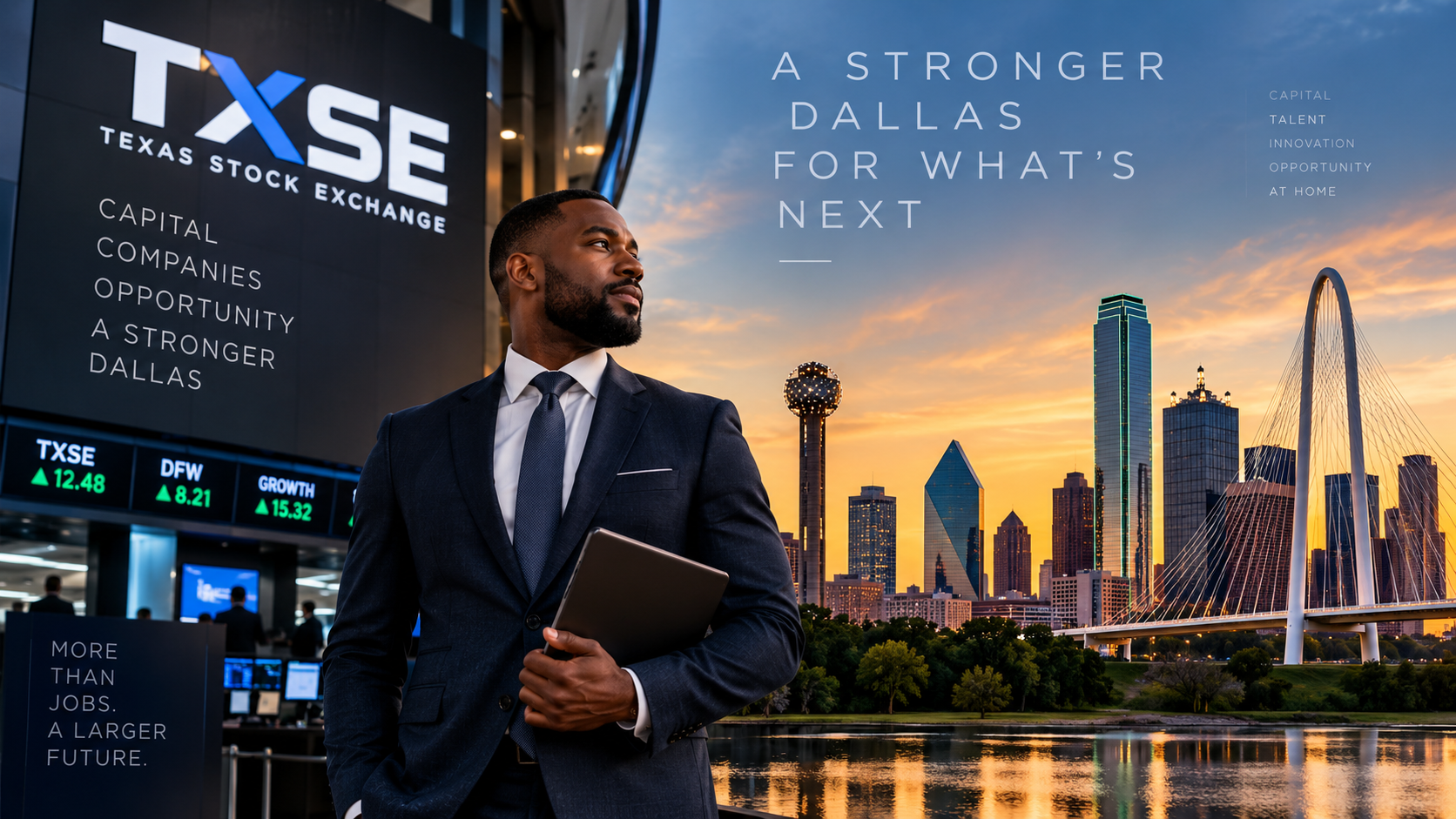
If Dallas develops a sufficiently large financial cluster, a company can specialize around the sector itself.
A cybersecurity consultancy that understands banking regulation and financial-market controls can sell a more specific capability than a general IT shop. The same is true for executive recruiting, compliance consulting, legal support, communications and workforce development.
That kind of specialization becomes easier to justify when several potential clients operate within the same regional market.
Students Should Pay Attention to the Infrastructure Behind Investing
The educational implications are easy to overlook because most people encounter the stock market as investors.
Students learn about stocks, mutual funds, compound returns and portfolio construction. They are less likely to learn how a market actually functions.
Someone has to engineer the systems that match orders. Someone monitors trading activity and regulatory compliance. Someone protects the infrastructure from cyberattacks. Lawyers help public companies comply with listing and disclosure requirements. Operations teams handle corporate actions and market events. Data companies process enormous volumes of information that investors and institutions rely on throughout the day.
TXSE says it built its own order-matching engine as part of the platform it launched this year.
For a Black student in Dallas studying computer science, cybersecurity, finance, law or data analytics, that broadens the range of careers associated with the financial sector. A person can work on the infrastructure of markets without ever becoming an investment banker or financial adviser.
That is especially relevant as Dallas colleges and universities think about how their programs connect with industries expanding around them.
Dallas Is Building Financial Depth, Not Replacing New York
The recent enthusiasm around “Y’all Street” sometimes encourages comparisons that do not help much.
New York remains the center of the U.S. securities industry, with generations of accumulated firms, capital, talent and professional networks. Dallas does not need to displace it for the developments underway here to matter.
A more useful measure is whether DFW is becoming deep enough that finance professionals can build entire careers here.
Goldman Sachs and Morgan Stanley are making major physical investments. JPMorgan Chase already operates at substantial scale. NYSE Texas has opened its Dallas headquarters. Nasdaq has established a Texas exchange presence. TXSE began trading in July and is preparing to host primary listings.
Energy Transfer gives the newest entrant its first large corporate test.
For Black professionals and entrepreneurs, the practical implications will depend on what develops around these institutions over time: which specialties expand, which schools build relevant programs, which local firms become vendors, who advances into leadership, and whether professionals can move among employers without leaving North Texas.
Those questions will tell us more about Dallas’ progress as a financial center than the number of times someone uses the phrase “Y’all Street.”
The October 5 Energy Transfer transfer will be worth watching because it moves Dallas’ financial ambitions into an area the city has historically had very little role in: the market infrastructure behind the ticker symbol.

