 Posted by
 Hey beautiful people all across the land of DFW. Well, well, well what kind of R&B pop-up scandal did we experience this past Chris Brown-Usher Concert weekend? More importantly, what business lesson can Black American and African businesses learn from it?
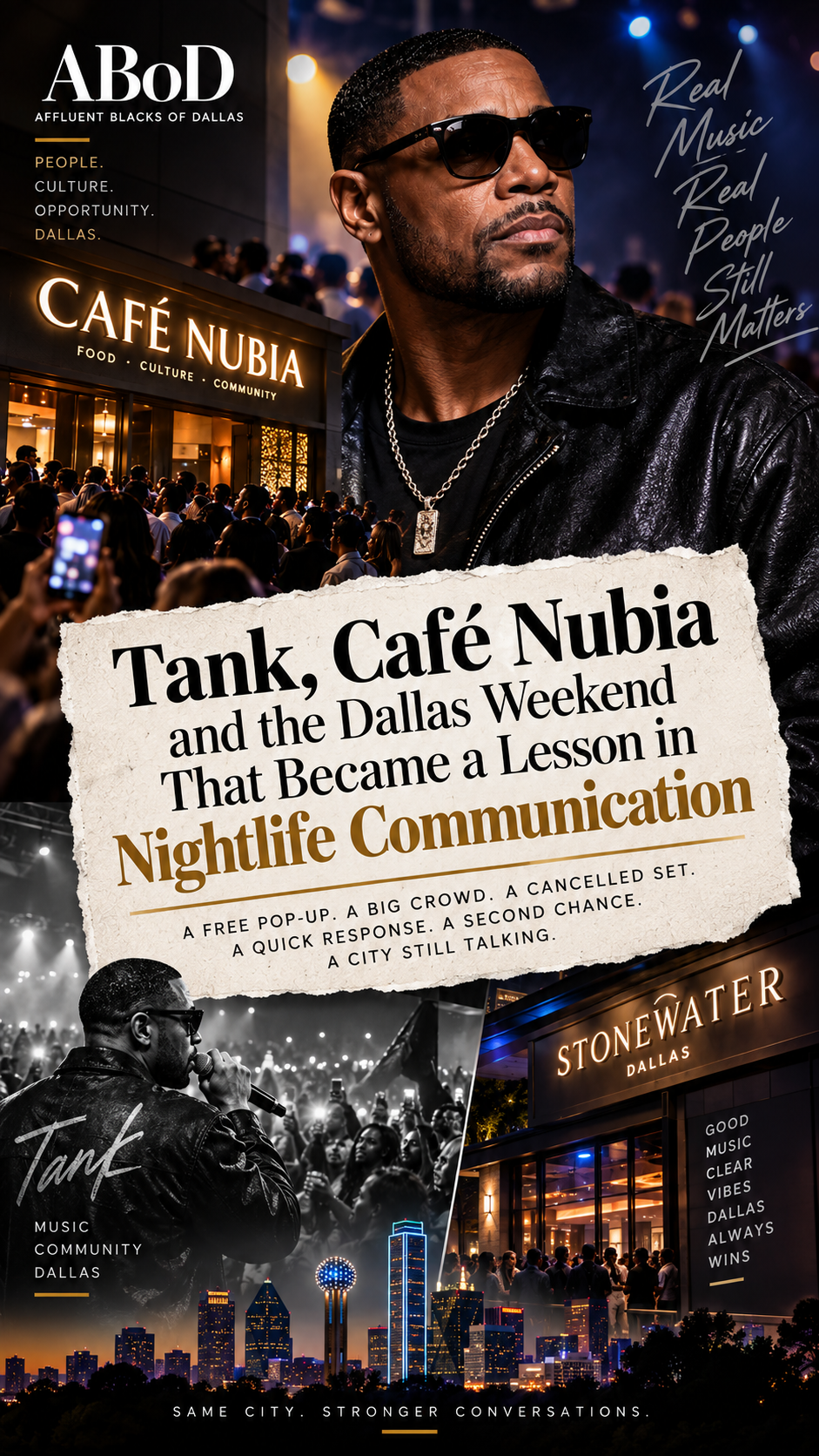
Dallas was already in an R&B mood when Tank announced a free Saturday afternoon pop-up at Café Nubia on Sept 12 to show appreciation to his fans.
The timing helped. With Chris Brown and Usher drawing attention in the city that weekend, Tank’s appearance felt like the kind of side event that can quickly become its own attraction: a well-known singer, a local venue and the possibility of seeing him in a much more intimate setting than the massive, world class arena that is AT&T Stadium in Arlington, west of Dallas and east of Ft. Worth.
The surprise event was scheduled from noon to 3 p.m. Fans arrived early, the room filled, phones came out and the DJ kept the crowd occupied while people waited for Tank.
By the time he arrived, around 2:15 p.m., anticipation had been building for hours. Lines were long as the brutal Dallas summer sun brought as much heat as the fireballs did later that night at the concert (yes, I was there and the concert pyrotechnics pushed out blasts of heat each time CB and Usher summoned them).
Then the afternoon started to unravel. Oh boy, not this again…
As Tank himself told the fans, technical problems with the sound system prevented the performance from going forward as expected. For the sweating fans who had been waiting much of the afternoon, that alone would have been frustrating. But by then, another issue was already beginning to dominate the conversation online.
Pay attention…
Confusion Over the $50 Minimum
Some attendees reported that they were being asked to meet a $50 dining minimum inside Café Nubia. There were also reports of table minimums reaching roughly $500. One disgruntled fan said that if they ordered a meal, they still had to pay this huge fee just to eat it at any table.
That “pop up fee” (or “price gouging” as many fans called it) immediately collided with what many people thought they were attending: a free Tank appearance.
Café Nubia later said the $50 was a dining minimum rather than an admission charge. From the venue’s perspective, that distinction was important. From the perspective of someone who arrived after seeing a “free” event promoted online and was then told that a minimum spend applied, it was easy to understand why the two felt similar. Tank directly expressed similar frustrations right there at the venue, pretty much saying this was not what was negotiated.
That gap in expectations became one of the central issues of the day.
The problem was less about whether a restaurant can impose a dining minimum and more about whether people understood the policy before they arrived. If an event is promoted primarily through an artist’s social media, many attendees may never see separate venue policies unless those details are included in the original promotion. At this point, integrity matters.
Once people began sharing their experiences online, the explanation came after the frustration had already taken hold. And that frustration grew into a social media PR disaster for Nubia that is still reverberating as even Tariq Nasheed weighed in on his podcast the morning of September 15, 2026. He was very colorful, to put it mildly.
Social Media Filled in the Gaps
Videos from the event began circulating across TikTok, Instagram and Dallas nightlife pages. Some showed the crowd. Others focused on the dining minimum, Tank’s arrival or the fact that the expected performance did not happen.
Comment sections quickly became a mix of firsthand accounts, assumptions, criticism and people trying to piece together what had occurred.
That sequence matters because nightlife controversies now develop in public while the event is still happening. A venue may still be trying to solve a sound problem while attendees are already posting videos describing the experience to thousands of people. This kind of PR meltdown can happen to any business that loses sight of its value proposition to the customer base.
By the time Café Nubia had an opportunity to explain its side, many people had already formed an opinion. In public relations, you can’t unring a bell, and social media can ring it across an entire city in a matter of minutes. Videos, complaints and firsthand accounts had been circulating for hours, and many people had already decided what they believed had happened.
Tank Addresses the Situation
And now for a masterclass on PR control. Tank responded publicly rather than allowing the confusion to sit unanswered.
He apologized to fans, said he had not authorized the disputed fees and acknowledged that people were disappointed. He also said he intended to make the situation right.
That response was especially important because most fans do not know how responsibilities are divided among an artist, a venue and any promoters involved. If the artist’s name is the reason people showed up, the artist is often the person they hold responsible when the experience falls short, even when the artist does not control every part of the event.
Tank’s statement gave people a clearer sense of where he stood and helped separate his promotion of the appearance from the policies people encountered at the venue.
He also did something more concrete the following day…
A Second Dallas Appearance
On Sunday night, Tank hosted another pop-up at StoneWater on the other side of Dallas.
The second event became part of the story because it gave fans another opportunity to see him after Saturday’s disappointment. Reports from attendees were considerably more positive, with fewer complaints about pricing, entry or production problems. Of course, no venue is perfect as a few fans did chime in about past SW problems, but it’s not if a business has problems, it’s how they resolve them that counts. Comment below if you agree or disagree.
StoneWater’s organizer also made a lighthearted reference to the previous day’s controversy on social media, giving Dallas nightlife followers something else to talk about.
More importantly for Tank, he had said he would return and make things right for fans, and he followed through with another appearance. Good job.
Café Nubia Responds
Café Nubia later issued a public apology addressing the confusion surrounding the dining minimum, the size of the crowd, the technical problems and the frustration that followed. For many fans, it was too little, too late.
The venue also apologized to Tank and to members of the Dallas nightlife community.
Its response helped clarify that the disputed $50 was intended as a dining minimum rather than a ticket price. That explanation answered an important question, although it could not undo the fact that many attendees had already experienced the policy as a surprise.
For venues hosting celebrity appearances, that’s probably the most useful part of this story to examine.
People rarely arrive at these events having studied the operational relationship between the performer, restaurant and promoter. They see an Instagram post or flyer, recognize the artist and decide whether to go.
If the venue has requirements that materially affect the experience, those details need to travel with the promotion.
So What Happened?
Based on the public accounts and statements surrounding the weekend, there doesn’t appear to be a need to turn this into a story about deliberate deception.
Several promo and business problems happened at once.
Fans believed they were attending a free Tank event. Café Nubia had dining policies that some attendees apparently didn’t know about beforehand. The crowd created additional pressure on the venue. Then the sound system failed at the moment everyone was waiting for the main performance.
And oh boy…social media did the rest.
None of that makes the frustration unreasonable. People gave up part of their Saturday, traveled to the venue from across DFW (and we know how big that is) and waited to see an artist whose appearance had been promoted as free. They had every reason to expect the basic conditions of the event to be clear before they arrived.
At the same time, the venue’s explanation matters too. A dining minimum is not automatically the same thing as secretly charging admission, even if poor communication made it feel that way to customers at the door.
The more accurate description of the weekend is probably a breakdown in coordination that became much larger once it reached social media. To be fair, one can imagine how tempting it would be to try to make a profit in an industry where many restaurants are going out of business or are barely making it due to razor thin profit margins. And as many regulars of Café Nubia noted, there are many times this venue does not have a lot of people. So to get a sudden upsurge in customers at the last minute, and with a fixed supply of food and beverages to serve them, to the venue owners, Tank’s pop up hit them like a hurricane.
Nevertheless, you can’t gouge prices like they do in hurricanes, either, if you want to stay in business.
Should they have planned their inventory better? Of course. But there are not many business courses on scaling from a small venue to a national-level one for a pop-up celebrity appearance.
In fact, for a celebrity pop-up like Tank’s, Café Nubia’s challenge wouldn’t simply be “buy more food and liquor.” The real problem is temporarily converting a normal restaurant/nightlife operation into a high-volume event operation for several hours. The best approach would have been to build a one-day event operating model around expected attendance, throughput, and inventory velocity.
The biggest changes should have been:
- Forecast attendance in tiers. Instead of planning from normal Saturday traffic, create scenarios such as 300, 500, 750, and maximum legal capacity. Use RSVP counts, social-media reach, artist popularity, prior event history, and walk-up assumptions. Inventory and staffing should be tied to those scenarios. Yes, even for a last minute pop up, they still should have worked possibly around the clock on these scenarios.
- Reduce the menu aggressively. A normal restaurant menu is too complex for a celebrity surge. Offer perhaps 5–8 high-volume items that can be prepped in quantity and served quickly: wings, sliders, flatbreads, fries, salads, and a few premium options. Every additional SKU increases kitchen congestion and inventory risk.
- Create event-specific beverage packages. Preselect a small number of cocktails, beer, wine, bottled water, and nonalcoholic drinks. Batch eligible cocktail components in advance and stage backup inventory close to service areas. The goal is reducing bartender touches per transaction.
- Set par levels based on servings, not cases. Management should calculate expected drinks and food portions per guest. For example, if the planning assumption is 500 guests averaging 2.5 drinks, the bar should be modeled around roughly 1,250 drink servings plus a safety buffer—not “whatever we normally order on Saturday.”
- Arrange temporary overflow storage. A small venue may physically lack refrigeration and dry-storage capacity for a national-act crowd. They could use refrigerated trailers, secured mobile coolers, nearby commissary space, or scheduled vendor replenishment rather than trying to cram everything into the existing kitchen.
- Negotiate emergency replenishment with distributors. For a one-off celebrity event, I would want prearranged same-day or rapid replenishment for high-velocity items such as bottled water, beer, mixers, ice, proteins, and disposable service items.
- Pre-stage inventory by service station. Do not make every bartender or server repeatedly return to the main storage room. Each bar should begin with its own calculated par inventory, with runners responsible for replenishment.
- Separate ordering from fulfillment. At very high volume, one person taking an order, another preparing it, and another delivering it can outperform the normal full-service model. Dedicated food runners and barbacks become especially important.
- Use multiple points of sale. A celebrity crowd can overwhelm three or four terminals very quickly. Mobile POS devices, dedicated beverage stations, and express lines for limited-menu items reduce queues and increase revenue capture.
- Add event-only labor. The appropriate staffing model may require temporary bartenders, barbacks, kitchen prep staff, security, hosts, runners, bussers, and an event operations lead. The normal Saturday crew should not be expected to absorb a 2x or 3x demand spike.
- Control the flow of people before they reach the bar. RSVP confirmation, clearly defined reservation/table policies, capacity monitoring, and separate lines for tables versus general admission prevent the food-and-beverage operation from being hit by an uncontrolled surge.
There is also a strategic point that relates directly to the controversy.
The $50 minimum may have been trying to solve the wrong problem
A dining minimum can make economic sense when a restaurant gives up normal table inventory for a free celebrity appearance. The venue still needs enough revenue per guest to cover food, beverage, labor, security and the opportunity cost of the event. But if attendees first learn about that requirement at the door, the revenue-management mechanism itself becomes a customer-experience problem.
A better approach would have been something like:
“Tank Pop-Up! Free Admission. RSVP required. Café Nubia is a full-service restaurant; a $50 per-person food-and-beverage minimum applies to seated guests. Table reservations have separate minimums. Standing-room access subject to capacity.”
But since Tank had already negotiated a free performance, depending on the business model, they could have separated the audience into clear categories: free standing-room access, reserved dining with a disclosed minimum, and premium tables with explicitly published minimum spends.
That would allow Café Nubia to protect its economics without making customers feel as though a free event suddenly became a $50 event when they arrived.
The operational model I would have used
For something like Tank, I would treat Café Nubia almost like a temporary festival venue rather than a restaurant hosting a busy Saturday. About 48–72 hours before the event (Not sure when Tank notified Nubia), I would freeze attendance projections, establish the limited menu, place supplemental orders, confirm overflow refrigeration and schedule extra labor. Also, it’s ok for a venue to either politely say No to a celebrity if their venue can’t handle the surge, or at least work with another nearby venue to share the opportunity so that capacity can be handled.
The night before, food prep would be completed to safe limits, beverage stations assigned their opening pars, POS devices tested, and backup inventory labeled by station.
On the day of the event, one manager would function as an event command lead rather than managing a normal shift. That person would watch four numbers continuously: crowd count, inventory burn rate, kitchen ticket time, and bar wait time.
If one metric started deteriorating, the operation would adjust immediately: for example, suspending slower menu items before the entire kitchen became overwhelmed.
That’s how a small local establishment can behave operationally like a much larger venue for four or five hours without permanently building national-scale infrastructure.
This is truly a case study for our ABoD audience, while giving Black-owned restaurants, lounges and event operators practical guidance on demand forecasting, inventory, staffing, pricing communication and reputation management.
A Dallas Nightlife Story Worth Paying Attention To
This episode also says something about the expectations surrounding Dallas nightlife.
The city’s Black entertainment scene includes restaurants, clubs, promoters, DJs, influencers and increasingly high-profile celebrity appearances. The audience is paying close attention to the experience they receive, particularly when pricing and access are involved. A few here in DFW and around the country are already painting all of Dallas Black nightlife with a broad brush because of this scandal.
People screenshot flyers. They compare what was advertised with what happened at the door. They share wait times, cover charges and table policies with friends before the night is over.
That makes clarity part of the product.
If an event is free but carries a dining minimum, say so in the original promotion. If reservations, table purchases or minimum spends are expected, put those details where people will see them before they leave home.
The same principle applies to artists and promoters. When several parties are involved in producing an event, the public should not have to figure out afterward which person controlled which part of the experience.
By Sunday night, the immediate controversy had already started to cool. Tank had returned for another appearance. Café Nubia had apologized and explained its position. Fans had said plenty.
Dallas will move on to the next event, as it always does.
But the screenshots, videos and comment threads from this weekend are a reminder that a few unclear details can become the story just as quickly as the celebrity everyone came to see.
Affluent Blacks of Dallas covers the people, businesses, entertainment and issues shaping Black life across the Dallas-Fort Worth region.

