 Posted by
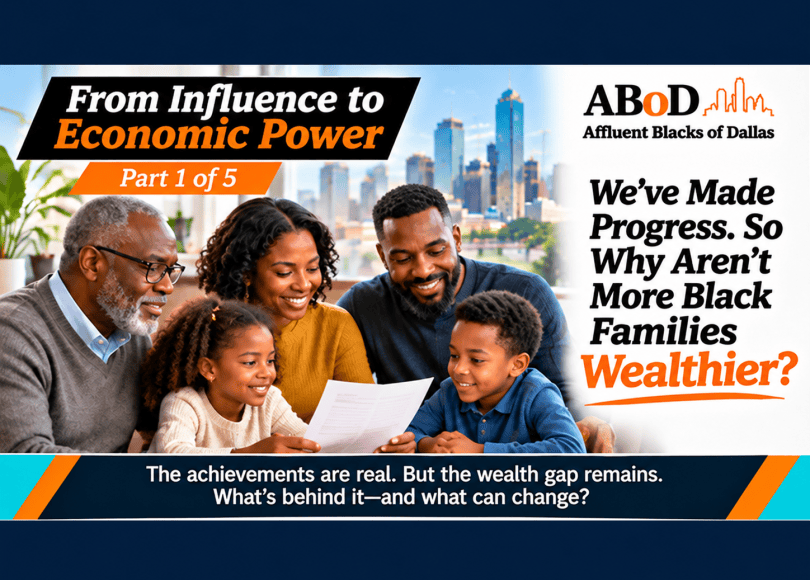
From Influence to Economic Power — Part 1 of 5
Black achievement is visible across Dallas–Fort Worth. Turning that achievement into lasting family wealth requires a closer look at ownership, opportunity, and what we pass to the next generation.
There is no shortage of Black success in Dallas–Fort Worth.
We see it in corporate leadership, medicine, technology, real estate, entertainment, and entrepreneurship. We see families celebrating graduations, professionals advancing into higher-paying roles, and business owners creating opportunities that did not exist a generation ago.
Those accomplishments deserve recognition.
But they also raise a question: Why can so much progress coexist with such a persistent wealth gap?
The answer starts with a distinction that often disappears in conversations about success.
Earning more money and building wealth are connected. They are not the same achievement.
Income Supports Your Life. Wealth Gives You Options.
Income is money coming in, whether from wages, business earnings, investments, or other sources. Wealth, usually measured as net worth, is what remains when you subtract debts from the value of what you own.
A household can have a strong income and a modest net worth. Another can earn less while owning a paid-down home, investments, or a business with transferable value.
That difference matters when life changes.
Income helps cover this month’s expenses. Wealth can help a family withstand a layoff, care for a relative, finance an opportunity, or give a child a stronger financial start.
For affluent and upwardly mobile Black families, the challenge is therefore larger than reaching a particular salary.
It is converting earnings into assets—and preserving enough of those assets to create choices beyond the next paycheck.
Progress Does Not Erase Different Starting Points
Education, professional advancement, and entrepreneurship can expand opportunity. But families do not enter those opportunities with identical resources.
One graduate may begin a career with student debt and relatives who need financial help. Another may begin with tuition already paid, assistance with a home down payment, and an inheritance invested years earlier.
Both can work hard. Both can make responsible decisions. Their financial starting points still differ.
Over time, those differences can compound.
A down payment can make homeownership possible sooner. An emergency fund can prevent expensive borrowing. Family capital can give an entrepreneur room to test an idea. An inheritance can become an investment instead of being absorbed by overdue bills.
This does not diminish the achievement of families who succeed without those advantages. It helps explain why individual achievement alone cannot tell the entire story of household wealth.
History Reaches Into Today’s Balance Sheets
The racial wealth gap did not begin with today’s spending decisions.
Slavery, discriminatory housing and lending practices, segregation, and unequal access to economic opportunity shaped who could accumulate assets and transfer them to descendants.
Those barriers operated through institutions as well as individual encounters. Their effects can persist through the assets families inherited—or never had the opportunity to acquire.
That history does not mean every Black family has the same experience. Nor does it mean every present-day financial outcome can be explained by one cause.
It means that an honest discussion of wealth must consider both what households do with their resources and how they gained access to those resources in the first place.
Personal agency and structural conditions belong in the same conversation.
Visibility Is Only One Kind of Power
Black cultural influence is evident in music, sports, fashion, entertainment, and public conversation.
But visibility does not automatically deliver ownership.
An audience can help a company generate revenue without owning a share of that company. A creator can attract attention while another business controls distribution, customer relationships, or intellectual property. A professional can help an organization grow while receiving little participation in the value being created.
These arrangements can still provide income and opportunity. The question is how much lasting value reaches the people whose work, ideas, and relationships help produce it.
For our community, that makes ownership a practical question:
Where do we participate as employees and customers, and where do we participate as owners?
The answer will look different for every household. It might involve retirement investments, home equity, a business, intellectual property, or other assets. Each carries its own costs, responsibilities, and risks.
Ownership creates possibilities. It does not guarantee success.
What This Means in Dallas–Fort Worth
For Black professionals and entrepreneurs in DFW, economic progress deserves to be measured beyond job titles, purchases, and appearances.
A promotion matters. So does what the additional income makes possible.
A business launch matters. So do profitability, reliable records, customer relationships, and whether the enterprise can operate beyond its founder.
Buying a home can matter. So do affordability, maintenance costs, financing, and the household’s ability to keep the property through difficult periods.
The useful question is not simply, “Are we doing better?”
It is, “Which parts of our progress are becoming durable financial security?”
That question can sharpen conversations within families, professional networks, business organizations, and community institutions.
It can also change what we celebrate.
Alongside the new venture, we can celebrate the established business becoming profitable. Alongside the graduation, we can discuss the cost of the degree and the opportunities it opens. Alongside the career milestone, we can recognize the quieter work of reducing debt, accumulating assets, and preparing an estate plan.
Building Wealth Requires More Than One Strategy
There is no single purchase, investment, business model, or policy that will resolve every family’s financial challenges.
At the household level, building wealth can involve managing debt, protecting against financial shocks, investing consistently, evaluating ownership opportunities, and planning how assets will transfer.
At the community level, it can involve stronger business relationships, access to capital, professional networks, and institutions capable of connecting people to opportunity.
At the policy level, it requires examining the rules and practices that shape access to housing, credit, education, business opportunity, and asset accumulation.
These efforts can reinforce one another. Families need practical tools they can use now. They also have an interest in whether the surrounding economy rewards their work and provides fair access to opportunity.
A Better Measure of Progress
Black achievement is real. The ambition, skill, and persistence behind it are real.
The next step is asking what that achievement is building.
Can a family withstand a financial setback? Can it invest without relying on high-cost debt? Can a business grow beyond the founder’s daily labor? Can the next generation receive assets, knowledge, and options?
Those questions bring us closer to the meaning of economic power.
For Affluent Blacks of Dallas, this series begins with a straightforward proposition: Our progress deserves to become something we can own, sustain, and pass on.
About the series: “From Influence to Economic Power” is a five-part Affluent Blacks of Dallas series examining how Black achievement and cultural influence can translate into ownership, household wealth, and lasting economic opportunity.
You’re reading Part 1 of 5. The next installment will continue the conversation about the foundations of lasting economic power.

