
 Posted by
 Uptown, Victory Park and the Design District sit remarkably close to one another, but Dallas has never made it particularly easy to move between them without a car.
A highway, rail corridor, retaining wall or wide arterial can turn a short distance on a map into an awkward trip at street level. That has long been one of the contradictions of central Dallas: the city has invested heavily in strong districts while leaving surprisingly poor connections between some of them.
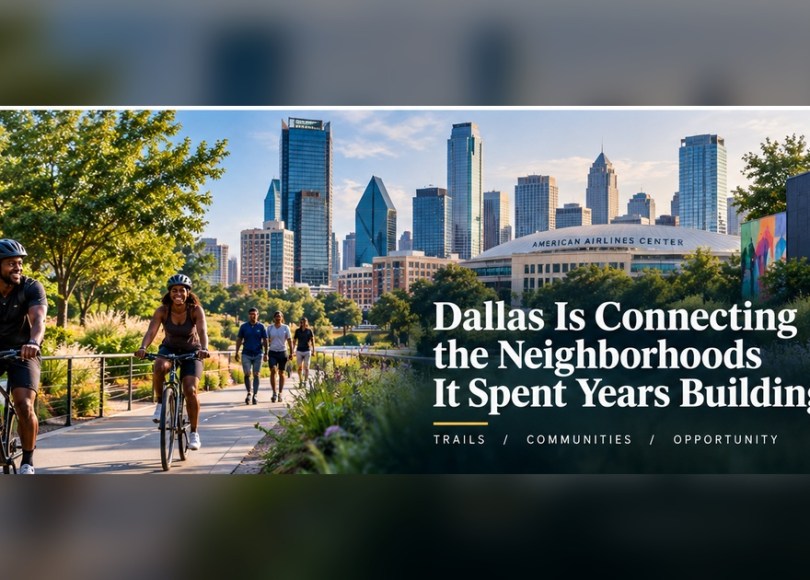
A new plaza beside American Airlines Center addresses one small part of that problem.
Loop Plaza is expected to open by the end of September, with a grand-opening celebration scheduled for October 20. The project will connect the Katy Trail, Hi Line Connector and Trinity Strand Trail near Houston Street, creating a more continuous pedestrian and bicycle route among Uptown, Victory Park, the Design District and areas farther west.
The project is modest compared with the office towers and mixed-use developments usually associated with Dallas growth. Its value comes from what it connects.
Strong Districts Are More Useful When People Can Move Between Them
Dallas already has successful pieces of an urban core.
Uptown combines dense housing, offices, restaurants and nightlife. Victory Park brings together residential development and one of the region’s largest entertainment venues. The Design District has evolved from warehouses and showrooms into a mix of galleries, restaurants, apartments, hotels and creative businesses.
Travel between those districts has often been easier by car than their proximity would suggest.
The Hi Line Connector improved part of that geography by creating roughly a mile of pedestrian and bicycle infrastructure linking the Katy Trail through Victory Park and the Design District to the Trinity Strand Trail. The route includes a 12-foot-wide path, lighting, traffic signals and a connection beneath Interstate 35E and active rail lines.
Loop Plaza addresses another awkward point near American Airlines Center by replacing part of a retaining-wall barrier with ramps, a bridge and public gathering space.
On its own, that will not change how Dallas functions.
What it does is make several investments around it work better together.
The Katy Trail Shows Why This Matters
Dallas already has a useful example of what happens when a recreational amenity becomes part of everyday city life.
The Katy Trail recorded more than 3 million visits last year, according to The Loop Dallas.
Its importance is not limited to exercise. The trail became part of how people experience Uptown and Knox-Henderson. Apartments advertise proximity to it. Restaurants and other businesses benefit from pedestrian traffic around it. Residents use it socially as well as recreationally.
That history helps explain why a connection such as Loop Plaza matters even if the project itself seems small.
Someone living near Uptown will have a more direct way to reach Victory Park and the Design District by foot or bicycle. A hotel guest near American Airlines Center can explore more of central Dallas without getting into a car for every trip. Restaurants and galleries gain another way for customers to reach them.
Those effects are difficult to isolate on an economic-development spreadsheet, but they influence how a district feels and how much time people spend in it.
Companies Compete for People After They Compete for Offices
Dallas has spent years becoming easier to sell to corporate decision-makers.
DFW International Airport provides global access. The region has a large workforce, extensive highways, substantial office inventory and a business environment that continues attracting corporate investment.
Once companies arrive, another question emerges: Can they convince talented people to move here and remain here?
That competition is more personal.
A technology professional comparing Dallas with Chicago, Washington, Atlanta or Denver may look at compensation, housing and career opportunities first. Daily life eventually enters the decision as well. Can she walk somewhere useful after work? Is there a park or trail nearby? Can she reach restaurants and entertainment without planning every trip around parking? Does the neighborhood feel like somewhere she wants to live, rather than simply somewhere convenient to an office?
Those preferences vary, of course. Plenty of people choose suburban space over urban walkability, particularly in a region as decentralized as DFW.
Dallas still benefits when its central neighborhoods offer both.
Quality-of-life investments become part of talent recruitment because employers are selling a metropolitan area along with the job.
Public Space Also Shapes the Business Environment
Better connections between neighborhoods can change where people spend money.
A person moving between Uptown, Victory Park and the Design District may encounter restaurants, galleries, coffee shops, hotels and entertainment venues that would have been less convenient to reach previously.
That additional access does not rescue weak businesses or guarantee that every storefront succeeds. It does expand the practical reach of a commercial district.
Developers pay attention to the same dynamics. Apartments become easier to market when trails, parks, restaurants and entertainment are nearby. Hotels benefit when guests can explore an area easily. Retail and hospitality operators look closely at pedestrian activity before deciding where to invest.
Public improvements can also raise property values and rents, which creates a different set of issues for smaller businesses and longtime residents. A more attractive neighborhood is not universally beneficial if the cost of remaining there rises faster than incomes.
Dallas has enough experience with redevelopment to know that improving a place and preserving access to it are separate challenges.
The More Important Test Is What Happens Beyond Uptown
For Black Dallas, the geography deserves particular attention.
Many affluent Black American families and professionals now live throughout DFW, including substantial populations in southern Dallas County, Collin County and communities farther from the traditional Black neighborhoods near the urban core.
A better-connected central Dallas makes the city more appealing as a destination, but the larger public value depends on whether similar infrastructure reaches neighborhoods where residents have historically had fewer high-quality recreational and transportation connections.
The Loop Dallas project is intended to create a 50-mile circuit by joining 39 miles of existing trails with about 11 miles of new links. The broader plan connects parks, schools, transit stations, commercial districts and neighborhoods across a much larger portion of the city than Uptown or Victory Park.
Southern Dallas is part of that work.
The Texas Transportation Commission approved $10.9 million in late 2025 for a segment of the Trinity Forest Spine Trail providing improved access to Parkdale Lake and roughly 110 acres of surrounding greenspace.
That investment matters because Dallas has historically distributed amenities and infrastructure unevenly.
A trail network concentrated around wealthy central neighborhoods would still be a valuable recreational asset. A network that also improves access among Southern Dallas neighborhoods, parks, transit and employment areas has a broader civic role.
The distinction will become clearer as the remaining sections are completed and people begin using them.
Real Estate Investors Already Understand the Value of Connectivity
People evaluating real estate rarely look at a property in isolation.
They study school districts, transportation projects, major employers, zoning, retail development and what is planned nearby. Parks and trails belong in that analysis because they affect how desirable a location becomes to residents and businesses.
The effect varies considerably from neighborhood to neighborhood. A trail does not automatically increase property values, and buying land beside a planned connection is hardly an investment strategy by itself.
Still, affluent consumers frequently pay for convenience and access to amenities. Developers respond to that demand when they choose sites and design projects.
Dallas’ continued investment in interconnected public space therefore belongs in the same conversation as housing, restaurants, offices and mixed-use development.
The relationship becomes especially visible around Uptown and the Design District, where relatively small improvements in pedestrian connectivity can influence neighborhoods already attracting significant private investment.
What Loop Plaza Can Actually Tell Us
Loop Plaza should not be asked to carry more weight than it deserves.
It will not fix Dallas traffic. It will not suddenly make the city walkable. It does not resolve transit limitations, housing affordability or the highways and rail lines that continue dividing neighborhoods.
Its usefulness is much more specific.
A physical barrier near American Airlines Center is becoming a connection among several heavily used parts of central Dallas. People who use the Katy Trail will be able to travel more easily into the Design District and Trinity Strand system. Victory Park gains a better connection to nearby neighborhoods. The larger Loop network moves one step closer to functioning as a continuous system rather than a collection of unrelated trails.
The most useful evaluation will come after people start using it.
Do more pedestrians and cyclists move between those districts? Do businesses notice additional traffic? Does the connection become part of everyday travel or remain primarily recreational? As the larger network expands, do residents farther south gain similarly useful connections?
Those are practical questions rather than architectural renderings, and Dallas will have several years to answer them.
For a region accustomed to measuring progress through corporate relocations and billion-dollar projects, Loop Plaza offers a smaller measure of growth: whether the neighborhoods Dallas has spent decades developing are becoming easier to experience as parts of the same city.

