
 Posted by
 The New Cost of Living Reality for Black Families in DFW
Why “Comfortable Income” Feels Out of Reach, and Where the Region Is Actually Heading Next
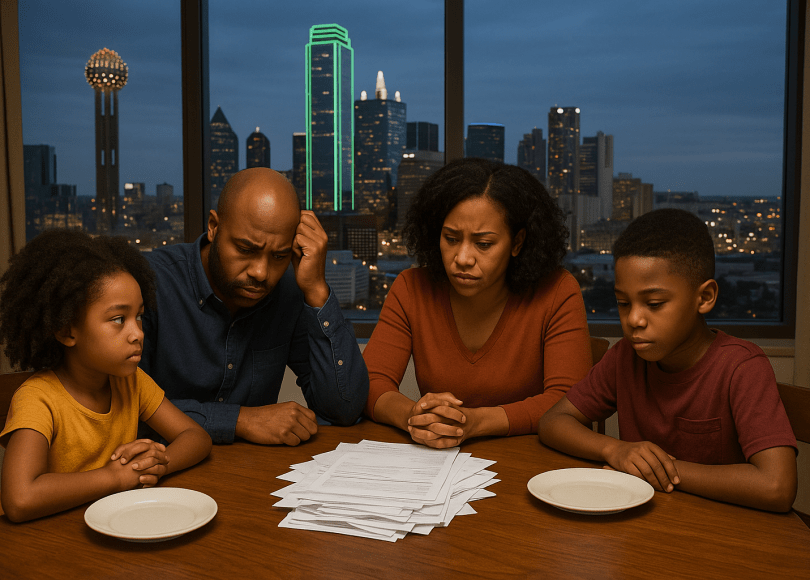
Over the past five years, Dallas–Fort Worth has transformed faster than almost any major region in the country. Home prices surged. Grocery bills jumped. Traffic congestion exploded. Entire suburbs that once symbolized “affordable middle-class living” now feel as expensive as some parts of California.
And for Black American families, the financial reality is even sharper.
While the median income in major U.S. cities sits far below what a family of four needs to live comfortably, the median income for Black American households nationwide is lower still, creating a situation where even high-earning Black professionals often feel financially stretched. Many find themselves supporting not only their own households, but also parents, siblings, nieces, nephews, or extended family who are struggling under rising costs.
As you can imagine, this phenomenon becomes a structural personal finance issue for us.

The Comfortable Income Gap Hits Black Families Hardest
Recent data shows that in most major U.S. cities, the income needed for a family of four to live comfortably ranges from $160,000 to $300,000+. But median incomes, even in strong markets, often sit between $60,000 and $90,000.
For Black households, the national median income is closer to $53,000–$58,000. This means:
- Black American families must climb a higher financial hill than any other group
- High-earning Black American professionals often serve as the financial anchor for extended family
- Wealth accumulation is slowed by “the Black tax” where the more financially stable of us often are supporting multiple households under one income stream
In DFW, this gap is widened further by regional trends that started around 2020.
2020 – The Beginning of Hyperinflation in Essentials
When the pandemic hit, supply chains collapsed. Then inflation arrived, and it hit the essentials hardest:
- Groceries
- Utilities
- Rent
- Auto insurance and maintenance
- Childcare
Black American families — who historically spend a higher percentage of income on essentials — felt this immediately. Just to maintain the same lifestyle Black American households had in 2019, many families now need significantly more income. And when “comfortable” income levels jump while median incomes stagnate, the strain becomes generational.
California and New York Migration Reshaped DFW Housing
Dallas–Fort Worth became the relocation capital of America:
- Californians fleeing $1.2M starter homes
- New Yorkers escaping high taxes and high rents
- Chicagoans looking for warmer weather and more opportunity
When higher-income residents from expensive states entered the DFW market, they could outbid long-time locals easily. This caused:
- A surge in home prices in nearly every suburb
- Rapid development in cities like Frisco, Prosper, McKinney, Melissa, and Mansfield
- Large real estate investors grabbing inventory before families could
Black American families — who have historically faced barriers to homeownership as we’ve written about and did videos about in the past — saw the goalpost move further away, even as incomes remained mostly flat.
Remote Work Hid the Problem…Until Return-to-Office Orders Hit
From 2020–2022, remote work kept the highways surprisingly smooth. People lived in affordable suburbs like:
- Rockwall
- Rowlett
- Prosper
- Princeton
- Burleson
- Mansfield
- Saginaw
- Crowley
They could work from home and occasionally drive into the city without stress. That illusion shattered when companies began enforcing Return-to-Office (RTO) policies.
Almost overnight:
- Highways became more congested than before 2020
- Commute times increased across DFW
- Suburbs not originally designed for heavy traffic became bottlenecks
- Infrastructure did not keep pace with population growth
Now even traditionally “easy commute” routes — like I-30 from Rockwall or 380 from Prosper — feel like LA Lite.
The Suburbs Are No Longer “Affordable,” They’re Just Further Away
Housing prices in the outer ring continued to climb:
- Prosper & Celina → luxury price levels
- Melissa & Anna → the new McKinney
- Mansfield & Midlothian → explosive growth without matching road expansion
- Princeton → once affordable, now bidding wars
- Aledo & Weatherford → becoming hot zones west of Fort Worth
For many Black families, it feels like the metroplex is pushing them further and further out — even if income hasn’t increased.
Sherman: The Next Breakout City?
A surprising microtrend is possibly emerging: Sherman is starting to look more attractive than DFW’s traditional suburbs. At least Big Tech corporations thinks so.
Why?
1. More Affordable Housing
Prices haven’t hit the inflated levels of Collin County.
2. Less Congestion
Sherman feels like the DFW of 2000 — open roads, open land, room to grow.
3. Serious Corporate Investment
Major tech companies now see Sherman as prime territory:
- Texas Instruments: massive semiconductor expansion
- Apple: major investments supporting supply chain and manufacturing initiatives
Corporate presence brings:
- High-paying engineering and tech jobs
- New infrastructure
- Higher public investment
- Long-term stability
4. A Chance to Build Wealth Early
Getting into Sherman could likely be like getting into Frisco or McKinney 15–20 years ago. For Black families looking to build generational wealth through real estate, Sherman may be the next major opportunity before prices explode. Just be nice to the locals and don’t bring your big city ways up there lol.
The ABoD Takeaway: Black DFW Families Must Navigate a New Economic Map
1. Comfortable income is now 2–4× the median — and the burden hits families of color hardest.
2. Prices for essentials have reset permanently higher since 2020.
3. Migration from expensive states reshaped DFW’s housing market.
4. Return-to-Office policies created the worst traffic DFW has ever seen.
5. Suburbs that were once affordable now resemble mini-Friscos.
6. Sherman, Texas is becoming the “next frontier” for affordable living and wealth building.
For affluent Black residents of Dallas–Fort Worth, this economic reality means two things:
- We must build stronger financial strategies for our own households
- We must continue supporting family members who are struggling in a system where the numbers simply don’t add up
As some like to say, the math is not quite mathin’. And the math has changed. In a related article, you’ll read about my technical assessment of how the explosive growth of Dallas-Ft. Worth has overwhelmed our regional infrastructure. One of the side effects of not being able to keep up with growth is that some of our local communities become even more marginalized as higher income areas get more technological attention from North Texas leaders. Link below. Do sign up for my STEM website and subscribe to the related Digital Transformer Guy channel on YouTube where I break down today’s problems behind the headlines into workable, AI-aligned digital technology solutions.
DFW’s Digital Infrastructure Is Buckling Under Growth – Samsona Corporation
Also on Medium
 Affluent Blacks of Dallas