 Posted by
 For many people in Dallas-Fort Worth, especially Cowboys’ fans, Emmitt Smith isn’t simply a famous name in a national news story. He’s an NFL running back legend, longtime North Texas businessman and recognizable member of the community. Our team has seen him out and about at some of the upscale spots we hang out at and he’s always come across as a great guy. That makes it especially important to separate what has actually been established from what one party to a lawsuit is alleging, especially when popular social media and YouTube channels do viral reports about this legal entanglement.
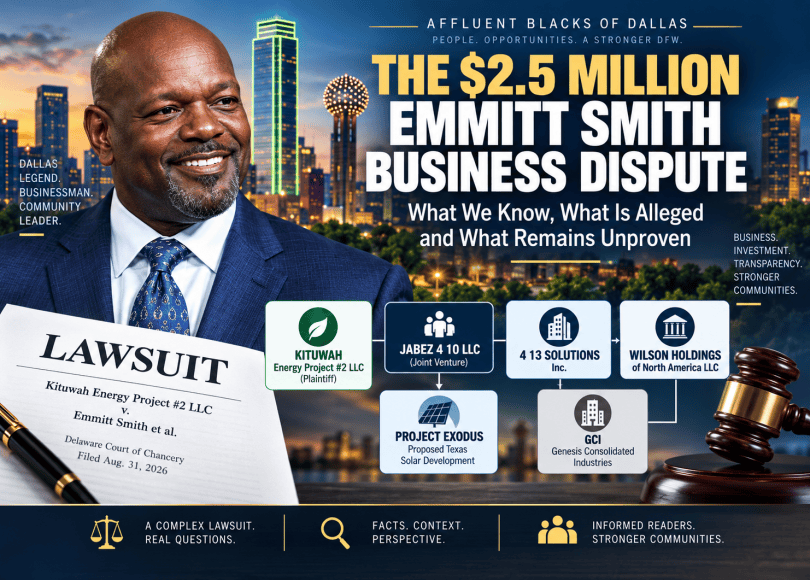
From what we know so far, Smith is among several defendants named in a civil lawsuit filed August 31, 2026, in the Delaware Court of Chancery by Kituwah Energy Project #2 LLC, an affiliate associated with Kituwah LLC and the Eastern Band of Cherokee Indians. The dispute centers on a $2.5 million loan connected to a proposed Texas renewable-energy development known as Project Exodus.
The most important fact to understand at the outset is this: a lawsuit has been filed, but the allegations have not been proven in court.
As of September 6, Smith has not publicly issued a substantive response to the allegations identified in the reporting we reviewed. Reuters, AP, NBC 5 and other outlets have reported unsuccessful attempts to obtain comment from Smith, 4 13 Solutions or other defendants. That means the public narrative currently available is heavily based on Kituwah’s complaint. A fair assessment therefore cannot treat that complaint as though it were a judicial finding of what actually happened.
How the deal was structured
Hold your breath as the allegation is very, very complex. In fact, maybe you shouldn’t hold your breath as it may take a while to unpack all of the tangled business relationships outlined in the lawsuit. As such, the business relationships are easier to understand if we separate the participants.
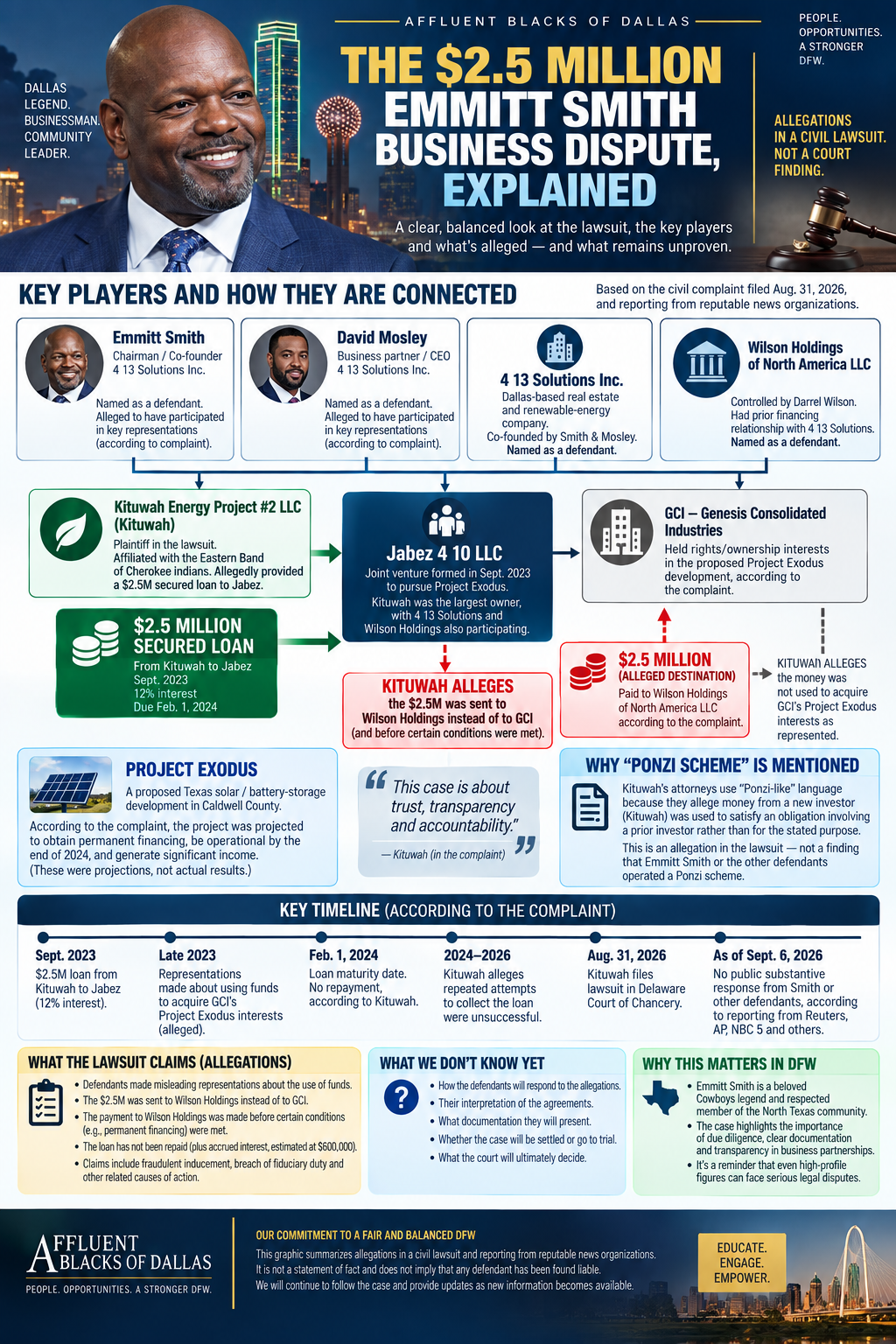
Emmitt Smith and David Mosley are business partners associated with Dallas-based 4 13 Solutions Inc., a commercial real estate and renewable energy business.
Kituwah Energy Project #2 LLC is the plaintiff that provided the money at issue. It is affiliated with Kituwah LLC, the economic-development organization owned by the Eastern Band of Cherokee Indians.
Wilson Holdings of North America LLC, controlled by businessman Darrel Wilson, had previous financial dealings with 4 13 Solutions.
The parties created another company, Jabez 4 10 LLC, as the joint-venture vehicle through which the Project Exodus transaction would operate. Reporting on the complaint indicates that Kituwah held the largest ownership position, with 4 13 Solutions and Wilson Holdings also participating. Smith and Mosley allegedly served in management roles.
Then there was GCI (aka “Genesis Consolidated Industries”). According to Kituwah’s account, GCI held rights or ownership interests associated with the proposed Project Exodus development that the new venture intended to acquire.
Keeping up so far?
Project Exodus itself was presented as a major Texas renewable-energy development. Court-related reporting describes projections under which the project could eventually receive permanent financing, become operational by the end of 2024 and generate substantial income. NBC 5 reports that materials cited in the complaint projected nearly $13.8 million of first-year net income.
Those were projections surrounding a proposed project, however, not actual operating results.
Where the $2.5 million enters the story
In September 2023, Kituwah provided $2.5 million to Jabez 4 10 LLC through a secured loan, allegedly thinking this was going to GCI. Reporting on the complaint says the loan carried 12% interest and was scheduled to mature on February 1, 2024.
Kituwah says it understood that its money would facilitate the acquisition of GCI’s Project Exodus interests.
This is where the two competing concepts at the heart of the lawsuit emerge. Pay close attention.
Kituwah alleges that, after the loan was funded, 4 13 Solutions represented that the $2.5 million had been paid to GCI as part of acquiring the Project Exodus interests. Kituwah says it did not receive documentation establishing that the promised acquisition had occurred.
Kituwah further alleges that its investigation later revealed something very different: the $2.5 million had been paid to Wilson Holdings instead. Oh what a tangled web we weave, it seems.
That alleged difference between the represented destination of the money and its actual destination is the core of the fraud dispute.
Why Wilson Holdings matters
Wilson Holdings wasn’t simply an unrelated company appearing at the end of the transaction. According to the complaint, it had previously provided financing in connection with 4 13 Solutions and was itself a participant in Jabez.
There was also apparently an arrangement under which Wilson Holdings could receive $2.5 million.
But Kituwah’s position is that the payment was conditional.
According to the lawsuit, Wilson Holdings was supposed to receive the $2.5 million after Project Exodus obtained permanent financing. Kituwah alleges that permanent financing was never obtained, meaning the condition authorizing that payment had not been satisfied.
The complaint goes further. According to AP and CBS Texas, Darrel Wilson reportedly told Kituwah that Wilson Holdings received the $2.5 million but that he didn’t know what had triggered the payment. Kituwah cites that information as support for its contention that the transfer should not have occurred when it did.
Wilson’s reported statement is relevant evidence, but it doesn’t by itself establish Smith’s intent or prove fraud.
Why you’ve seen the words “Ponzi scheme” in headlines
This deserves particular care. Check out this video by a well known YouTuber who does detailed videos about fraud-related scandals for more background on the Ponzi scheme angle. Kituwah’s attorneys use language comparing the alleged transaction to a Ponzi scheme because they contend money supplied by a new investor—Kituwah—was used to satisfy an obligation involving an earlier investor rather than for the purpose Kituwah says it was told the money would serve.
That allegation explains the analogy. But there is an important difference between saying:
“The plaintiff alleges the transaction was essentially like a Ponzi scheme.”
and saying:
“Emmitt Smith ran a Ponzi scheme.”
The second statement goes substantially beyond what has been established.
At this stage, the public record reviewed by ABoD shows a plaintiff making a Ponzi-like comparison as part of a civil fraud case. It does not show a court finding that Smith operated a Ponzi scheme. Nor should readers assume from that phrase alone the existence of the type of large, continuing multi-investor fraudulent operation normally associated with the term “Ponzi scheme.”
For that reason, ABoD would not characterize Smith as having run a Ponzi scheme based on the evidence presently available so far.
Why Smith is personally named
Another question readers may reasonably have is whether Smith has simply been pulled into litigation because his name is associated with 4 13 Solutions.
The complaint goes further than that.
Kituwah accuses Smith personally of participating in representations made while the investment was being negotiated. NBC 5 reports that the complaint cites emails attributed to Smith, including communications concerning the importance of Kituwah’s bridge financing. Kituwah has asserted claims including fraudulent inducement and breach of fiduciary duty against Smith.
That makes the allegations against him substantive rather than merely guilt by association with his company.
But again, an allegation that Smith personally made misleading statements is not proof that he knowingly did so. Questions about what Smith knew, what he believed about Project Exodus at the time, what the contracts permitted, who authorized the payment, and whether any statements were intentionally deceptive are precisely the kinds of factual questions litigation is designed to resolve.
What happened to the debt?
Kituwah says the $2.5 million note matured on February 1, 2024, without repayment.
The company says repeated attempts to collect the loan were unsuccessful and that none of the principal amount has been recovered. Recent reporting places accrued interest at roughly $600,000, which would bring the disputed amount above $3 million before additional legal expenses or other damages.
Kituwah is seeking repayment of at least the $2.5 million principal, along with interest, expenses and other relief that may ultimately be awarded.
A failure to repay a loan, however, does not by itself establish fraud. Businesses can default on legitimate loans for many reasons. Kituwah’s fraud theory depends on proving something more significant: that material representations were knowingly false or misleading when Kituwah relied on them in deciding to provide the money. This is not always easy to prove.
What would make the allegations more serious if proven?
Kituwah’s strongest allegation isn’t simply that Project Exodus failed. The more consequential accusation is that Smith, Mosley and their associates allegedly knew Kituwah expected its money to facilitate acquisition of Project Exodus, directed the money somewhere else, and then allegedly misrepresented what had happened to it.
If evidence establishes those propositions, the case could extend well beyond an unsuccessful renewable-energy investment or ordinary loan default.
But the phrase “if evidence establishes” is essential.
The defendants may dispute the interpretation of the agreements, the permitted use of the loan proceeds, control over Jabez, the circumstances surrounding the Wilson Holdings payment, the representations attributed to them, their knowledge and intent, or Kituwah’s calculation of its damages. This is why I’m a fan of doing due diligence with any business arrangement because business is war, and so legal agreements need close scrutiny at every step.
We should not invent those defenses on their behalf. Until Smith and the other defendants file substantive responses or make public statements, we simply do not know which arguments they intend to make.
What ABoD readers should take from the case right now
This is a serious lawsuit containing detailed allegations. It shouldn’t be dismissed simply because the best known defendant is a beloved Dallas Cowboys icon. It also shouldn’t be treated as a conviction because the complaint contains disturbing accusations.
Both principles can be true at the same time.
Kituwah deserves to have its allegations reported accurately. Smith and the other defendants deserve to have those allegations described as allegations unless and until evidence and judicial findings establish otherwise.
For Dallas-Fort Worth readers who know, admire or have interacted personally with Emmitt Smith, that distinction may be particularly important. Personal familiarity with Smith doesn’t disprove Kituwah’s claims. Likewise, an aggressively worded complaint doesn’t erase a person’s history or establish that the plaintiff’s version of events is correct.
The unresolved question isn’t whether Emmitt Smith has been accused of serious financial misconduct. He clearly has.
The unresolved question is whether Kituwah can prove it.
And at this early stage of the case, those are two very different things.
ABoD Editorial Note: This report concerns allegations in a civil lawsuit. No finding that Emmitt Smith, David Mosley, Darrel Wilson or the associated companies committed fraud has been identified as of September 6, 2026. Affluent Blacks of Dallas will update this report if the defendants file substantive responses, the parties reach a settlement, additional documentary evidence becomes public, or the court issues material rulings.

John the CEO
 Affluent Blacks of Dallas