
 Posted by
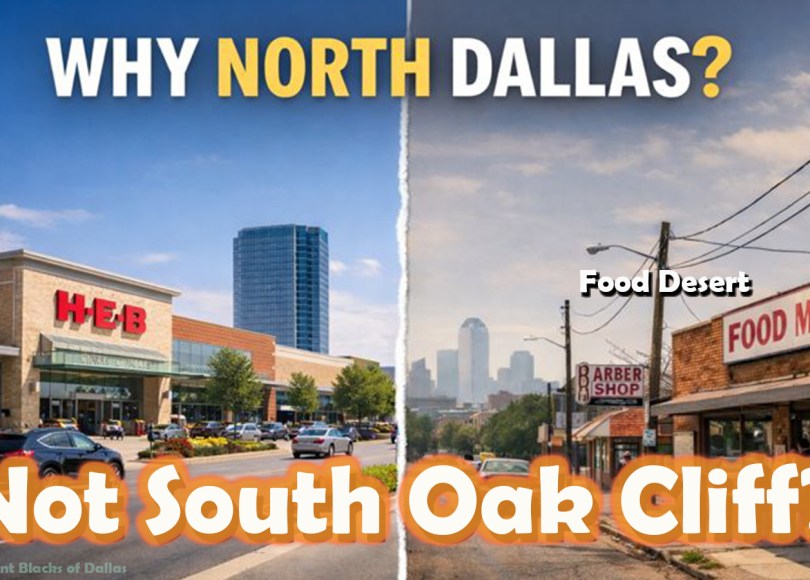
 Editor’s Note from John the CEO: As I was working on my year-end project planning stuff for 2026, I saw a report on TV about a brotha putting pressure on HEB to open a store in South Oak Cliff. He noted how the area has been struggling as a “food desert” – where there is no grocery store within a few miles – and since areas like Bottom District were turning things around, why not be the only store that Oak Cliff residents can go to? He spent about $8,000 of his own money to make the case.
And on the surface, it makes sense. He lays out his plea on hebwhy.net in case you want to check it out. I applaud him as I’ve been covering this topic over the years and have a modern business and AI-technology solution I’ve been working on for my Digital Transformer Guy YouTube channel and website (SamsonaSoftware.com) to address this.
However, is it really that simple to apply lots of emotional pressure on one of the best supermarket business models in the country? Grocery stores and supermarkets operate on razor thin profit margins, which is part of why Black American owned grocery stores gradually went out of business long ago. The last one I went to was in Oklahoma City in the late 1980s when I was a sophomore at OU. I knew the owner and learned why things were tough for him. Some of the bread on the shelves were molding, some milk outdated, etc. It wasn’t due to incompetence. The grocery store business model is very complex, and if one aspect of the operation goes sideways, a domino effect can bring it down.
South Oak Cliff is not the only food desert. DFW has several, as well as other cities around the country. The less fortunate among our communities would complain or apply pressure to stores to open up or at least not close an existing store. Yet these pleas fell on deaf ears due to shrinkage (mainly shoplifting, but also some produce spoils or things get damaged).
So the following article explains what the corporation sees when evaluating food desert areas as well as other more “desirable” areas such as the new HEB location opening up in North Dallas off Hillcrest. It’s not only median incomes, but also zoning, security, and many other factors. Trying to shame a store chain to open a store without addressing the real concerns of these executives will result in a polite “no.” But when you carefully put together a presentation that professionally addresses all the risks and how the community can partner with local leaders to make it more appealing from a business investment standpoint, then your chances for solving the food desert problem are considerably higher…
“THE HIDDEN COST: TIME”
Food deserts quietly tax families in ways spreadsheets don’t show.
Longer grocery trips mean:
- Less time with children
- More transportation costs
- More stress on working parents
- Fewer healthy meal options during busy weeks
For Black households already managing work, caregiving, and community responsibilities, this “time tax” compounds over years.
Solving food access is also about returning time to families.
Food access isn’t just about convenience.
It’s about health, family stability, and long-term opportunity.
That’s why so many people paid attention when an Oak Cliff activist publicly challenged H-E-B, asking why the company wouldn’t open a store in South Oak Cliff.
But the public conversation missed some critical facts — and misunderstood how grocery decisions are actually made.
H-E-B Is Not Avoiding Dallas
Despite popular belief, H-E-B is not ignoring the city.
• The company is actively advancing a full-size store in North Dallas
• H-E-B already operates Joe V’s Smart Shop locations inside Dallas (Buckner Blvd being one)
• Joe V’s is fully owned by H-E-B and designed for value-focused communities
The real issue isn’t whether H-E-B will serve Dallas.
It’s how grocery formats match neighborhood economics.
Why North Dallas Was the First Move
North Dallas offers conditions that make a traditional grocery store viable:
• Higher and more stable household incomes
• Larger grocery baskets
• Easier zoning and parking
• Lower security and shrink volatility
For a grocer entering Dallas city limits for the first time, this is the safest starting point.
Opening here first doesn’t mean other neighborhoods don’t matter.
It means the company is reducing first-store risk.
Why South Oak Cliff Is a Different Case — Not a Lost Cause
South Oak Cliff has real grocery demand.
But it also faces:
• Lower median household income
• Higher price sensitivity
• Smaller average baskets
• Higher operating friction
These realities don’t eliminate opportunity — they require a different model.
Trying to force a flagship store into this environment often leads to closures, broken promises, and deeper mistrust.
Joe V’s: The Model Built for This Moment
Joe V’s Smart Shop exists specifically for working-class and price-sensitive communities.
Its design prioritizes:
• Affordable pricing
• Essential groceries
• SNAP-friendly operations
• Smaller, more efficient footprints
The Joe V’s location on Buckner Boulevard shows that H-E-B will operate in lower-income Dallas areas when the format fits. Joe V’s is explicitly designed for:
Lower-income, price-sensitive trade areas
Smaller average baskets
Higher SNAP utilization
Tighter margins with lower capital risk
The Joe V’s location on Buckner Blvd demonstrates that H-E-B will operate in lower-income Dallas areas when the format fits the economics.
This directly contradicts the idea that H-E-B is ignoring Dallas or underserved communities.
That’s not automatically exclusion.
That’s strategy based on the color GREEN.
What Actually Brings a Store to South Oak Cliff
If South Oak Cliff wants sustainable grocery access, three things must align:
- The right format
A Joe V’s or hybrid value-based store — not a flagship. - Public-private partnership
City support for zoning, infrastructure, and safety. - Long-term accountability
Jobs, workforce pipelines, and measurable community impact.
Without these elements, no major grocer can make the numbers work — regardless of public pressure.
The Bigger Picture for Black Communities and the role of Dallas
Food deserts aren’t solved by shouting louder.
They’re solved when communities understand:
• How capital works
• How risk is priced
• How to negotiate partnerships that last
That’s how access turns into stability — and stability turns into generational progress.
It’s important to be clear:
Without meaningful participation from the City of Dallas, no large grocer will absorb the full risk of a food-desert location alone. A Joe V’s-style store in South Oak Cliff is a much easier proposition.
City action is not a bonus.
It is a prerequisite.
This includes:
• Faster permitting
• Infrastructure and lighting investment
• Public safety coordination
• Workforce development support
If the city wants different outcomes, it must offer different conditions.
Final Thought
South Oak Cliff doesn’t need promises.
It needs a store that opens and stays open consistently.
That happens when:
• The right grocery format is chosen
• The city shares responsibility
• The community demands solutions that last and are a win-win for all stakeholders.
This is how food access becomes health, stability, and long-term wealth.
Stay tuned as a deeper dive into this very important topic is coming in early 2026. Subscribe to our YouTube channel (“AffluentBlacks”) and my technology-business channel (“DigitalTransformerGuy”) which explores the technology solution for this problem. Take care.
 Affluent Blacks of Dallas